
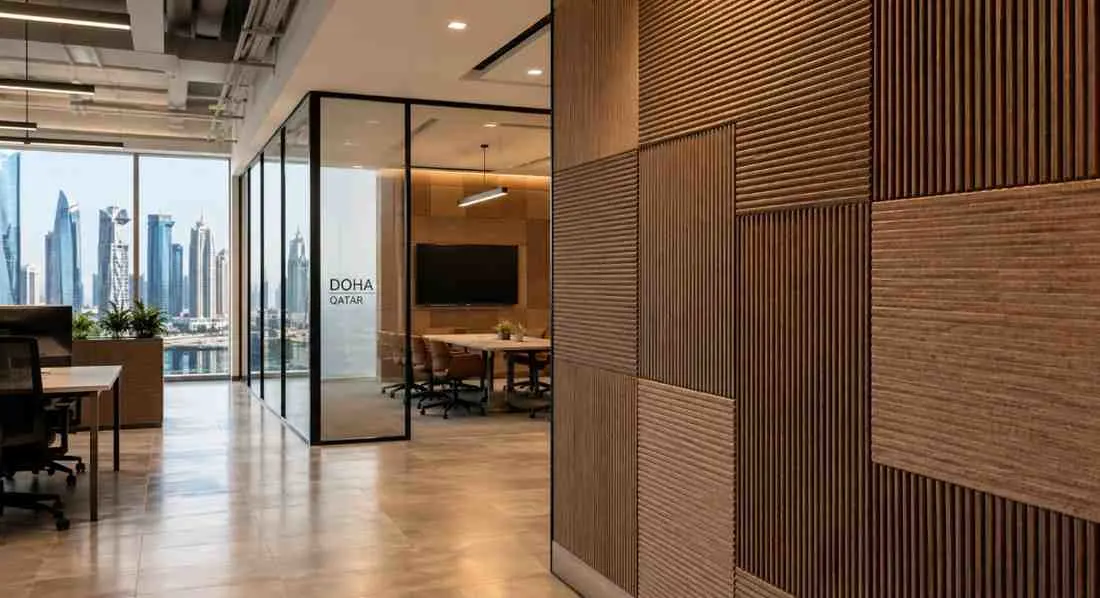
Doha’s open-plan offices often sit behind floor-to-ceiling glass with polished tile underfoot, and that combination bounces sound instead of absorbing it. Acoustic panels for offices have become one of the more practical fixes for that problem, catching sound waves before a shared workspace turns into a wall of overlapping calls and keyboard noise. The fix itself isn’t complicated. It comes down to what the wall is made of.
What Is the Real Noise Problem in Qatar’s Open-Plan Offices?
Most commercial towers in Doha favor hard flooring, glass partitions, and exposed ceilings for a clean look. Sound has nowhere to go in a room built that way, so it reflects off every surface and stacks up as the day goes on. Background noise in a typical office usually sits somewhere in the 40 to 55 decibel range on a normal day. That’s well below the levels the Occupational Safety and Health Administration regulates for hearing protection, but concentration starts slipping long before noise reaches that threshold, especially during tasks that need sustained focus, like drafting a contract or reviewing a set of drawings.
Acoustic wall panels Qatar businesses are adding to meeting rooms and reception areas to address this at the source, meaning the wall itself, rather than trying to manage the noise after it has already spread across the floor.
How Acoustic Panels for Offices Actually Work
The panels work through absorption rather than blocking. A dense core material, usually a rigid, high-density PU foam, sits inside the panel and traps sound energy as it passes through instead of sending it straight back into the room. Anam Trading and Contracting builds its acoustic wall panels around that same PU foam core, paired with a moisture-resistant foil backing, using the construction it also applies across its wooden and PVC panel lines, just tuned here for sound absorption rather than water resistance.
That build matters for two reasons. It cuts down reflected sound rather than only muffling it slightly. And because the core also carries heat insulation properties, the panels do double duty during a Doha summer, quieting a room while softening how much heat transfers through an exterior wall.
Material and Installation Choices for Qatar’s Climate
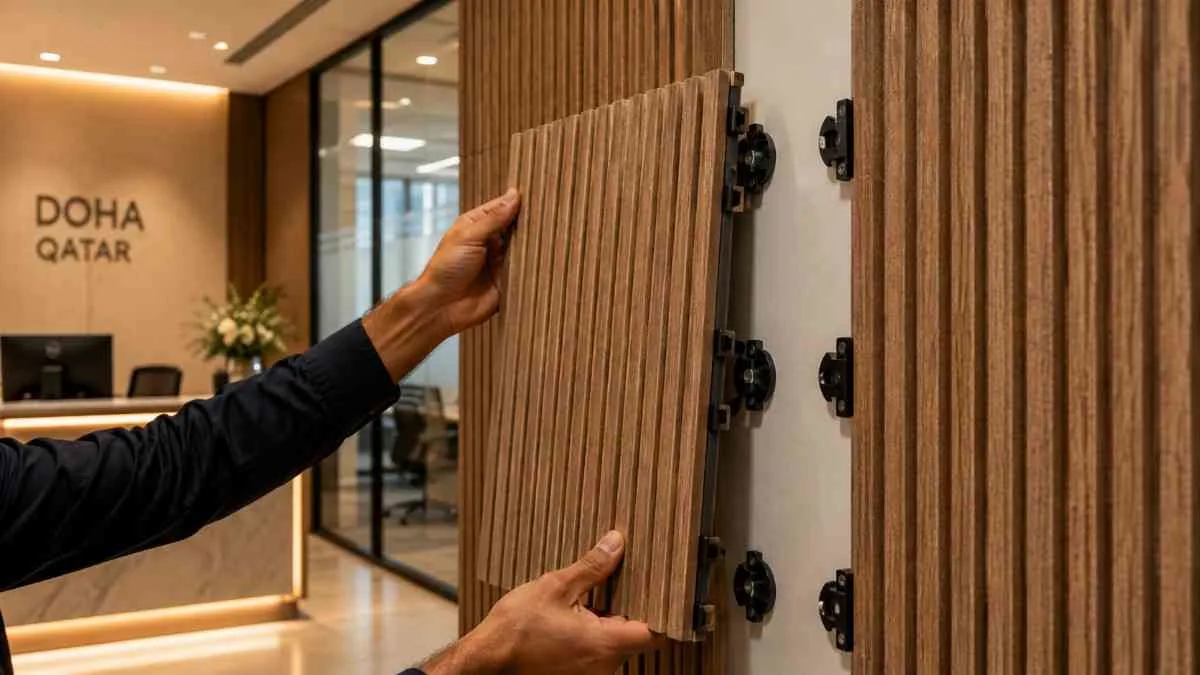
Installation is often what decides whether an office moves forward with this or not. The panels use an interface plug system that clips into place over an existing wall, so there’s no wet trade work and no waiting days for adhesive to cure before the room is usable again. A meeting room or reception area can often go from bare wall to finished panel within a single working day, which matters for a business that can’t afford to close a client-facing space for a week.
The panels also carry a UV-protective top coat over an embossed metal or wood-textured surface, so the finish holds up under direct sunlight through glass facades, a real factor for offices that sit behind large windows for most of the year here.
Where Acoustic Treatment Makes the Biggest Difference
Anam Trading and Contracting lists office interiors, commercial fit-outs, retail spaces, and hospitality environments among the applications for its acoustic panel range, alongside home theaters and recording studios. Inside a typical Doha office, the areas that benefit most are the ones with the least existing sound absorption already in place: open-plan desks near a printer bank, glass-walled meeting rooms, and reception areas where a receptionist ends up on the phone within earshot of a waiting client.
Not every wall needs treatment. A single feature wall behind a reception desk, or panelling along one side of a boardroom, is often enough to bring reflected sound down without covering an entire room. Anam’s wall panel range lays out PVC, wooden, kitchen, and acoustic options side by side, which helps when a project needs more than one panel type across different rooms.
Final Thoughts
Acoustic panels for offices are a wall finish decision as much as an acoustic one. The right choice for an office in Qatar depends on how the space actually gets used day to day: a call center floor, a boardroom, or a reception area that doubles as the first impression for every visitor. It usually helps to start with a walk-through of the space and a look at where sound is genuinely reflecting, rather than treating every wall the same way. What does the loudest hour in your office actually sound like, and where is it coming from?
FAQ
Absorption panels act on reflected sound, not the source, so results depend on how much bare wall gets covered. A single feature wall in a meeting room noticeably reduces echo. Treating three or four exposed surfaces in an open floor plan is what actually brings the overall volume of a busy desk cluster down.
Yes, in most cases. The panels use an interface plug system that clips over a flat, secure surface, so existing tiles, paint, or plaster usually stay in place. It avoids wet trade work and demolition, which keeps a client-facing space usable while the rest of the office gets treated in stages.
They’re built with a UV-protective top coat and a moisture-resistant foil backing, so direct sun through glass facades and the humidity swings of a Doha summer don’t warp the surface. The same core material adds a layer of heat insulation too, which is a useful secondary benefit beyond sound control.
PVC panels are chosen mainly for water resistance in kitchens and bathrooms. Acoustic panels use a different core, built to absorb sound rather than repel moisture, suited to meeting rooms, open-plan floors, and reception areas instead of wet zones. Some projects end up using both, just in different rooms.
Start with whichever wall reflects the most sound back into the room, usually behind a reception desk, along a boardroom’s hard wall, or near a cluster of desks close to shared equipment like a printer bank. One well-placed wall often does more than thin coverage spread across an entire floor.