
Choosing flooring in Qatar isn’t just about looks. It’s about fighting dust, surviving the AC-cranking humidity, and making sure your living room doesn’t look dated in two years. You’re likely torn between the classic feel of broadloom and the modern flexibility of carpet tiles vs. traditional carpets.
The short answer? If you want easy maintenance and a custom look, go with tiles. If you want seamless, plush comfort for a bedroom, stick with traditional rolls. We’ve seen enough Qatar villas to know that the right choice depends entirely on how you live. At Anam Trading & Contracting, we help homeowners navigate these choices every day.
Table Of Contents:
Why Window Treatments in Qatar Are Changing
Do 3D Curtains Really Work in Modern Doha Villas?
Breaking the “Standard” Mold
The Technical Side (Without the Boring Bits)
Keeping Things Cool
Final Thoughts
FAQ
Which Flooring Handles the Qatar Climate Better?
The humidity and dust in Doha can be a nightmare for floor fabrics. Traditional wall-to-wall carpets tend to trap sand deep in the fibers, making them harder to deep-clean without heavy equipment.
Carpet tiles are often built with denser, low-pile materials. They don’t hold onto dust as stubbornly. Plus, if a spill happens during a dinner party, you aren’t replacing the whole floor. You just pop out one tile, clean it, or swap it. It’s practical. It works.
The Real Cost: Carpet Tiles vs. Traditional Carpets
Let’s talk about money. On paper, traditional carpet rolls might look cheaper per square meter. But the hidden costs bite. You have to pay for specialized underlay and professional stretching, and often, there’s a lot of wasted material when cutting for odd-shaped rooms.
Carpet tiles have almost zero waste. You buy what you need. Installation is fast—sometimes even a DIY job if you’re handy. Over five years, tiles usually cost less because you don’t need a professional cleaning crew every time someone drops a cup of Karak.
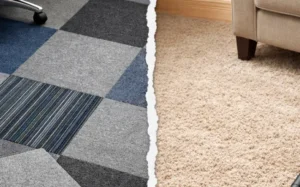
Are Carpet Tiles Too “Office-Like” for a Home?
This is the biggest fear we hear. “I don’t want my living room to look like a bank.” That’s old-school thinking. Modern modular flooring comes in textures that mimic wool, linen, and even stone.
You can mix and match colors to create “area rugs” built directly into the floor. You can’t do that with traditional broadloom without expensive custom binding. Modular floors give you creative freedom. Broadloom gives you that classic, unbroken “ocean” of fabric.
| Feature | Carpet Tiles | Traditional Carpets |
|---|---|---|
| Installation | Fast & Easy | Requires Professionals |
| Durability | High (Heavy Duty) | Moderate to High |
| Repair | Replace one tile | Must patch or replace all |
| Feel | Firm & Structured | Soft & Plush |
How to Handle Spills and Stains in Doha
Dust storms are a reality here. Sand gets everywhere. With traditional carpets, that sand acts like sandpaper on the base of the fibers, wearing them down over time. It’s the main reason floors here start looking “bald” after a few years.
Carpet tiles usually have a hard-backed base. Sand can’t settle into the subfloor as easily. If you have kids or pets, the choice is almost a no-brainer. Being able to wash a single square in the sink saves you a massive headache.
Soundproofing and Insulation
If you live in a multi-story villa, noise is a factor. Traditional carpets are the gold standard for silence. The thick padding underneath absorbs the sound of footsteps and voices better than almost anything else.
Tiles are quieter than tile or marble, sure. But they don’t have that “hushed” library feel of a thick roll of carpet. If you’re flooring a home cinema or a nursery, the extra plushness of traditional carpet is worth the maintenance trade-off.
Final Thoughts on Carpet Tiles vs. Traditional Carpets
Your home in Qatar deserves a floor that can handle the heat, the dust, and the occasional coffee spill. When weighing carpet Tiles vs. traditional Carpets, think about the room’s purpose. Use tiles for playrooms, hallways, and home offices. Save the traditional rolls for the spots where you want to sink your toes into luxury.
Ready to see samples that actually fit your style? Reach out to us at Anam Trading & Contracting, and let’s find your perfect match.
FAQ
Honestly? Yes. Most use a “peel and stick” or a light adhesive. If you can use a utility knife and a ruler, you’re halfway there. Just make sure your subfloor is bone-dry and level first.
Not anymore. The high-end ones have patterns that hide the seams perfectly. If you buy the cheap, thin ones, yeah, it’ll look like a call center. Spend a bit more on “plank” styles for a high-end look.
You’re usually looking at a “patch job.” A pro cuts out the bad bit and glues in a new piece. The problem? The new piece won’t have the same wear or sun-fading as the rest, so it often sticks out like a sore thumb.
Carpet tiles. They have shorter fibers and less “fluff,” which means they trap fewer allergens. Plus, the ability to deep-clean them more often keeps the air in your home a lot fresher.