
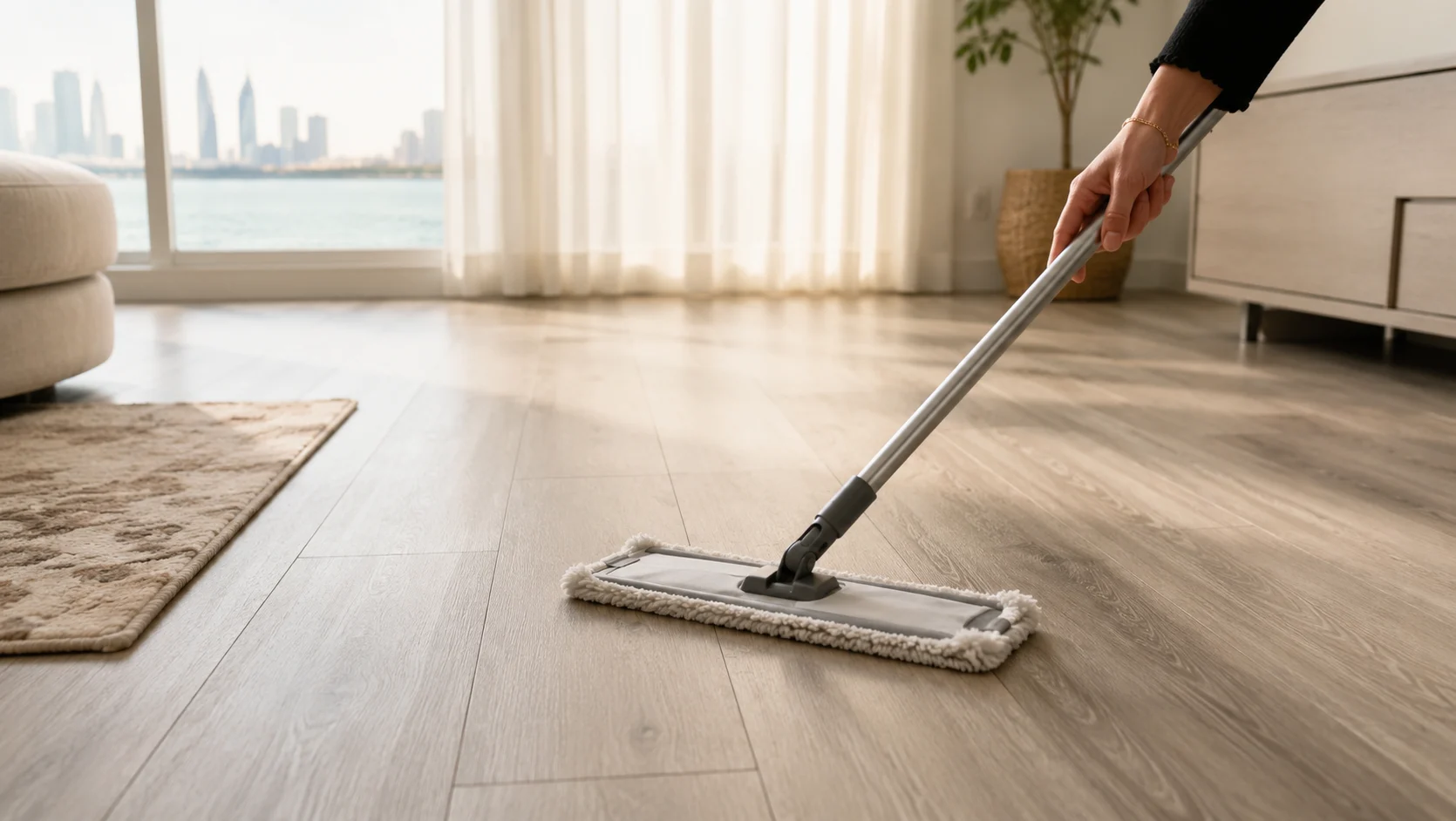
Dust from a shamal storm settles into floor seams within hours, not days, which is exactly why SPC flooring maintenance in Doha works differently than it does in cooler, drier climates. SPC planks click together rather than being glued down, so grit trapped along the joints wears the surface faster than water ever could. Understanding the daily, weekly, and monthly rhythm of care keeps that wear in check.
Here is a straightforward guide to help you decide.
What Are the Daily Habits That Protect Vinyl Plank Flooring?
A soft-bristle broom or a vacuum with the beater bar switched off should handle daily grit removal. Beater bars are built for carpet fibers, and running one across a rigid plank surface scuffs the finish over time. Spills need attention within minutes, not because SPC is vulnerable to moisture (it isn’t, since the core is fully waterproof) but because standing liquid attracts more dust and turns into a slip risk on a smooth surface.
Entrance mats matter more here than in most markets. Fine construction dust and desert sand carried in on shoes act like sandpaper under foot traffic. A mat at every exterior door catches most of it before it reaches the plank surface.
Weekly Cleaning for Waterproof Flooring
Once a week, a damp mop with a pH-neutral cleaner lifts the film of oil and dust that dry sweeping leaves behind. Ammonia-based cleaners and vinegar solutions strip the protective wear layer over repeated use, so a manufacturer-approved neutral cleaner is worth the extra step. Steam mops are best avoided altogether. The heat and moisture they push into the seams can loosen the click-lock joints over months of use, even on a floor rated fully waterproof.
Wring the mop until it’s barely damp. SPC handles moisture on the surface without issue, but pooling water at baseboards or door thresholds can eventually work into the subfloor beneath the planks.
Monthly Inspection Points
A monthly walkthrough catches problems while they’re still cheap to fix. Check the seams near windows and balcony doors first, since Doha’s temperature swing between air-conditioned interiors and outdoor heat causes more expansion and contraction stress at those points than anywhere else in the home. A seam that has started to lift usually means the floor needs a few days to acclimatize with the AC set to a stable temperature, not a full plank replacement.
Look under furniture for felt pad wear too. Chair and table legs without proper pads are the single biggest cause of scratches on rigid core flooring, and the pads themselves need replacing every few months once they flatten out. A quick check of skirting boards and transition strips rounds out the monthly routine, since loose trim is often the first visible sign of subfloor movement.
Why Does the SPC Flooring Maintenance Routine Matter?
SPC flooring is built with a stone-plastic composite core, a design that gives it a five-year warranty backing and a sound reduction layer that cuts noise transfer by roughly two decibels. It’s also formaldehyde-free, which matters in homes with kids or pets who spend time close to the floor. None of those built-in properties replace basic care, though. Recommended SPC flooring maintenance practices from the resilient flooring industry confirm that even moisture-resistant, stain-resistant flooring needs a consistent daily and weekly routine to hold its finish over years of use, and products meeting international performance benchmarks such as ASTM’s resilient floor covering standards are tested specifically for wear resistance under exactly this kind of routine handling.
For homeowners comparing options before installation, browsing the SPC flooring range is a useful starting point, since click-lock installation and wear layer thickness both affect how demanding the long-term maintenance schedule will be.

Final Thoughts
A floor that gets thirty seconds of daily attention and a proper weekly mop rarely needs anything more than that monthly walkthrough to stay in good shape for years. The team at Anam Trading & Contracting sees the same handful of seam and threshold issues come up again and again in Doha homes, almost always tied to that daily AC-to-outdoor temperature swing. What does your current cleaning routine look like, and where might the seams around your AC vents or balcony doors need a closer look this month?
FAQ
Daily dry sweeping or vacuuming handles grit before it scratches the surface. A weekly damp mop with a pH-neutral cleaner takes care of oils and film buildup. Homes near construction zones or with pets may need daily damp wiping in high-traffic zones instead of weekly.
It’s not recommended. Steam mops force heat and moisture into the click-lock seams, and repeated exposure over months can loosen those joints even though the surface itself is waterproof. A microfiber mop with minimal water does the same cleaning job without that risk.
The rigid stone-plastic composite core allows planks to interlock mechanically, which speeds up installation and lets the floor expand and contract slightly with temperature changes. That flexibility is also why gaps at seams are usually a temperature issue, not a structural fault.
Sharp temperature swings between air-conditioned rooms and sun-heated glass cause the planks to expand and contract unevenly at those points. Letting the room sit at a stable temperature for a few days often lets the seam settle back down on its own.
Yes, since the core is fully waterproof and resists staining from spills. The main precaution is at door thresholds, where pooled water can eventually seep beneath the plank edges if it isn’t wiped up. Routine wiping keeps that from becoming an issue.