
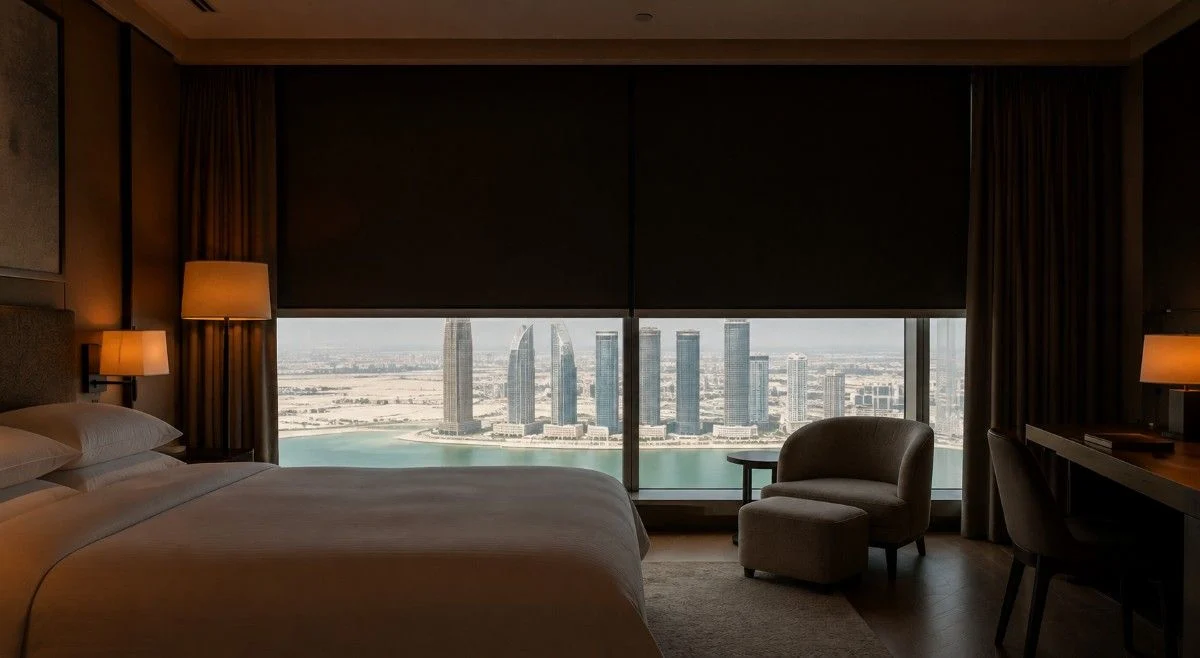
A guest checks into a Doha hotel room after a long-haul flight, pulls the curtains shut, and the desert sun still floods through the fabric. That gap between what a curtain promises and what it delivers is exactly the problem hotel blackout blinds are built to close. For properties in Qatar, where daylight hours run long for much of the year, blocking light isn’t a design preference. It’s part of what guests are paying for.
Why Does Room Darkening Matters for Hotel Guests
Hotel blackout blinds work differently from standard drapery because the fabric itself is engineered to stop light rather than just filter it. Anam Trading and Contracting, a Doha-based supplier operating for 13+ years, makes its blackout roller blinds from a polyester-linen blend with an acrylic coating, a combination built to block up to 99.9% of light and 100% of UV rays. A 2023 systematic review and meta-analysis in Science of the Total Environment found that maintaining bedroom darkness at night is a feasible way to reduce sleep problems , which lines up directly with why hotels treat light blocking as a comfort standard rather than a design extra. That level of blocking matters most in guest rooms facing east, where morning sun hits earlier than most travelers want to wake up.
The company traces its roots back to Aspire Blinds before growing into its current form, and blinds remain one of its core product categories alongside flooring, doors, and wall panels. For hotels, the blinds sit under the same that residential and commercial clients use, just specified for higher-traffic, higher-turnover rooms.
What Hotels Actually Need from Blackout Fabric
A guest room isn’t a bedroom in a private home. Housekeeping opens and closes the blinds dozens of times a week across hundreds of rooms, and the fabric has to hold up to that without fraying, sagging, or losing its blackout performance after a year of use.
This is where the material specification does the real work. The blackout fabric used in these blinds carries a light fastness rating of grade 4 and a washing fastness of grade 4 to 5, with fray-free edges built for repeated handling. None of that shows up in a photo, but it’s the difference between blinds that still block light properly after eighteen months and ones that start letting in a thin strip of glare along the seams.
Noise reduction is a secondary benefit that hotels tend to undervalue until a guest complains about traffic outside a street-facing room. Thicker blackout material dampens some of that external sound, which pairs naturally with the light-blocking function since both come from the same dense weave.
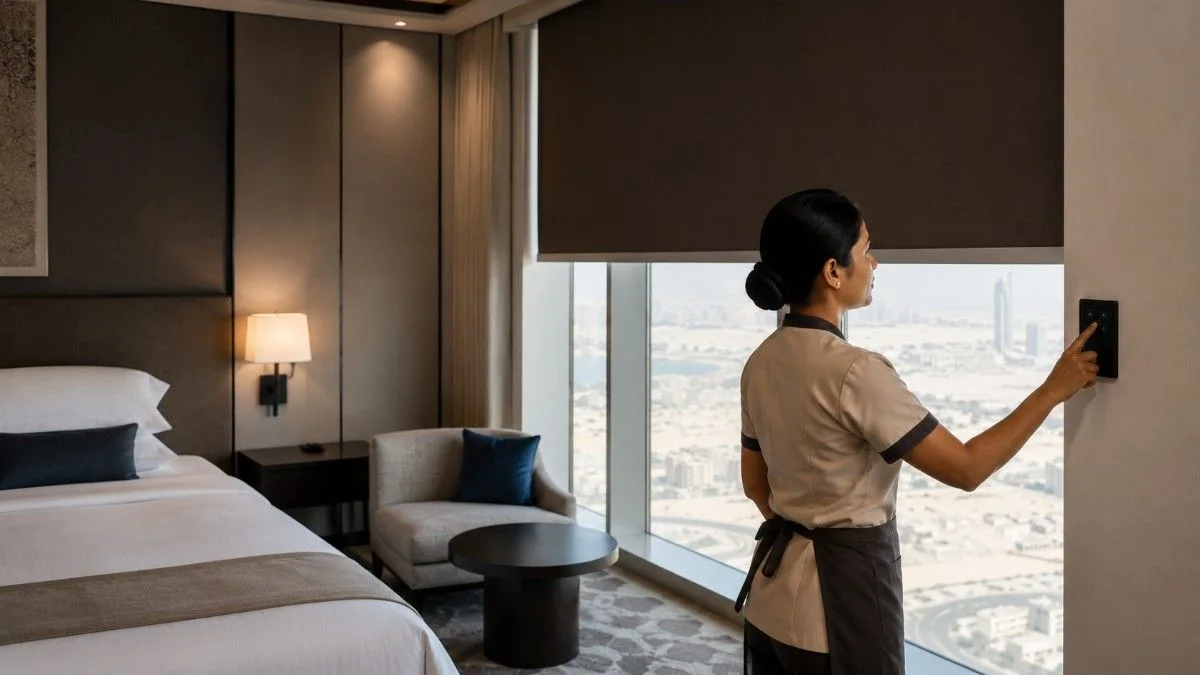
Motorization and Room Type Fit
Larger properties or high-end suites often move toward motorized blackout blinds rather than manual pull cords, mainly for consistency across rooms and ease of housekeeping. Anam Trading’s blackout roller blinds are available with tubular motor options rated for widths up to six meters and loads up to 35 kilograms, depending on the motor variant, which covers everything from standard guest rooms to larger suite windows or meeting room glass walls.
Applications listed for the product extend beyond bedrooms into commercial spaces, and the company’s own FAQ content specifically names hotels among the sectors it supplies alongside offices, retail stores, and large construction projects. That’s a useful signal for procurement teams comparing suppliers. A blind maker that treats hospitality as a niche add-on tends to spec residential-grade fabric for commercial volume. One that lists hotels as a standing category has likely already worked through the wear-and-tear questions that matter at scale.
Sourcing and Fit-Out Considerations
For hotel groups managing renovation or new-build fit-outs in Qatar, custom sizing matters more than it does for a single homeowner. Rooms rarely share identical window dimensions across floors, especially in older properties that have gone through partial renovations. Suppliers offering made-to-measure blackout blinds, rather than fixed stock sizes, cut down on the gaps and light leaks that come from forcing a standard width onto a nonstandard window.
Anam Trading operates from a showroom and logistics base in Doha’s Birkat Al Awamer district and works directly with commercial and contracting clients on measurement, material selection, and installation, which keeps the sourcing conversation local rather than routed through an overseas supplier with longer lead times.
Final Thoughts
Blackout performance in a hotel room isn’t a single feature guests notice consciously. It’s the reason they sleep through a Doha sunrise instead of waking up two hours early, and the reason a room facing a busy street still feels quiet. If your property is weighing a blinds upgrade, the fabric specification and warranty terms matter more than the marketing photos. What’s the light leak tolerance you’re currently working with, and would your guests notice the difference if it dropped to near zero?
FAQ
Good blackout fabric blocks up to 99.9% of light, not a full 100%. There’s almost always a faint edge glow where the blind meets the window frame unless it’s fitted with side channels. For a hotel room, that tiny margin is rarely noticeable once the lights are off.
It depends heavily on the fabric’s fastness ratings. Material rated grade 4 to 5 for washing and rubbing resistance, paired with fray-free edges, tends to hold up well under the frequent handling that housekeeping puts it through, often lasting years rather than months before performance drops.
For larger properties, yes, mainly because motorization keeps operation consistent across dozens or hundreds of rooms and reduces wear from manual cords. Smaller boutique properties with a handful of rooms may not see enough return to justify the added expense.
Somewhat. The dense weave that blocks light also dampens some external sound, though blackout blinds alone won’t solve a serious noise problem. They work best as one part of a broader soundproofing approach, not a standalone fix.
Ask about custom sizing options, warranty length, fastness ratings for washing and light exposure, and whether the supplier has experience fitting commercial properties rather than only residential homes. A supplier that already lists hotels among its client types has usually solved the durability questions that come with high-turnover use.